
 Watch on YouTube
Premieres 27 October 2026 at 6pm UK time
The Old Fox's Library · Episode 7
The Great Fire of London and Pepys's buried cheese
A baker's oven, a city in flames, and a diarist who buried his parmesan.
London, September 1666: Pudding Lane, firebreaks blown with gunpowder, around 13,200 houses lost, a Frenchman hanged for a fire he probably couldn't have started, and the Monument's 202-foot secret.
Watch on YouTube Follow on TikTok
Share this story
What the fox said
Pull up a chair. Tonight's page: the Great Fire of London.
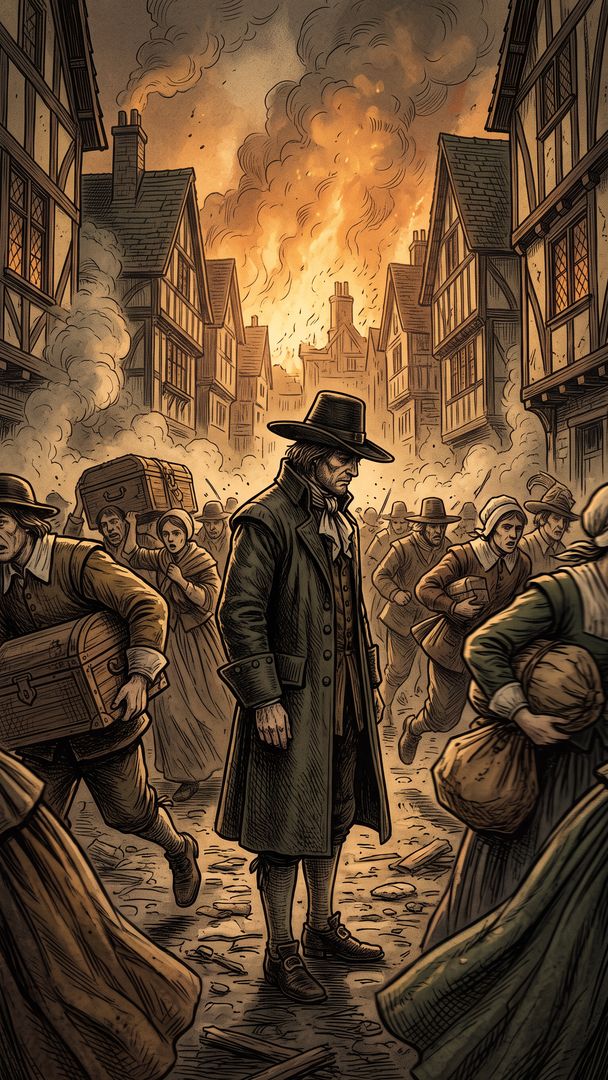
Sunday, the 2nd of September, 1666. In the small hours, London began to burn.
It started in Thomas Farriner's bakery on Pudding Lane. He was the King's baker.
Packed timber houses and narrow lanes let the flames spread fast.
The Lord Mayor reportedly shrugged it off. Later, Samuel Pepys found him worn out: "Lord, what can I do?"
Men pulled houses down, and blew some up with gunpowder, to make firebreaks.
Pepys and a colleague dug a pit in the garden and buried their wine... and his parmesan cheese.
In about 4 days, roughly 13,200 houses burned, and around 87 parish churches. Old Saint Paul's was a ruin.
Tens of thousands lost their homes. Only a handful of deaths were recorded, but historians think many more went uncounted.
A Frenchman, Robert Hubert, confessed and was hanged. Yet he seems to have reached England only after the fire began.
The city rebuilt in brick and stone, and Christopher Wren gave London a new Saint Paul's.
One to keep: Wren and Hooke's Monument is 202 feet tall, and stands 202 feet from the bakery's site.
Close the book. Keep your nose to the wind.
Sources
- The Great Fire began in the small hours of Sunday 2 September 1666 in the Pudding Lane bakery of Thomas Farriner, the King's baker; it seems the oven had not been properly put out (London Fire Brigade Museum; British Library; The National Archives; The Monument).
- Samuel Pepys recorded the Lord Mayor, Sir Thomas Bloodworth, crying 'Lord! what can I do?' as houses were pulled down to stop the fire; later, houses were blown up with gunpowder to make firebreaks (The Diary of Samuel Pepys, 2 and 4 September 1666; London Fire Brigade Museum).
- On 4 September Pepys and his colleague Sir William Penn dug a pit and buried their wine, and Pepys added his 'Parmazan cheese' (The Diary of Samuel Pepys, 4 September 1666).
- The fire burned for about four days and destroyed roughly 13,200 houses, around 87 parish churches and the old St Paul's Cathedral; estimates of the homeless range from about 70,000 to 100,000 (London Fire Brigade Museum; St Paul's Cathedral; London Museum).
- Only a handful of deaths were recorded, though historians think many more went uncounted (London Museum).
- A Frenchman, Robert Hubert, falsely confessed to starting the fire and was hanged; evidence suggests he arrived in England two days after it began (British Library, 'Robert Hubert and the Great Fire of London').
- London was rebuilt in brick and stone under the Rebuilding Act of 1667; Christopher Wren designed the new St Paul's, and the Monument, by Wren and Robert Hooke, is 202 ft tall and stands 202 ft from the site of the bakery (fireoflondon.org.uk; Designing Buildings; St Paul's Cathedral; The Monument; London Museum).
Spotted a mistake? Tell us in the YouTube comments and we'll correct it.